Free lesson preview: EWIS Groups 1 & 2 — Initial
EWIS — AMC 20-22 — Target Groups 1 & 2 — Initial Knowledge Training
Lesson 1 of 13, exactly as learners see it. No sign-in needed; practice answers are not saved.
- 5 hours learning
- 12 questions, 18 min
- Certificate at 75 %
Lesson 1 of 13
Introduction & Course Objectives
Scope, sources and author
Welcome to EWIS Initial Training TG1 TG2
This course delivers the knowledge element of initial Electrical Wiring Interconnection System (EWIS) training for personnel who maintain and inspect large aeroplanes. It is built around a single guiding idea: aircraft wiring is no longer a passive, "fit and forget" installation but an integrated aeroplane system with its own ageing characteristics, failure modes, inspection criteria and maintenance practices. By the end of the course you will understand what EWIS is, why it deserves dedicated attention, how the regulatory framework drives the work you do, and how to apply improved inspection and maintenance techniques in your day-to-day role.
What is EWIS?
The certification specification for large aeroplanes (CS 25.1701) describes EWIS as any wire, wiring device, or combination of these — including the devices used to terminate them — installed in any part of the aeroplane to transmit electrical energy or signals between two or more intended termination points. The definition is deliberately broad: it captures not just the conductors themselves but the supporting hardware that groups, routes and protects them.
- Wires and cables — the conductors that carry power and signals.
- Termination devices — connectors, terminal lugs and terminal blocks, splices, and ground/bond points.
- Termination points on electrical devices — including those on circuit breakers and other circuit-protection devices.
- Routing and protection hardware — clamps, cable ties and supports, conduits, raceways, grommets, and the shielding that bundles and protects the harnesses.
CS 25.1701(b) includes wiring inside shelves, panels, racks, junction boxes, distribution panels and equipment-rack backplanes. Paragraph (c) excludes internal EWIS components and equipment-owned external connectors of other electrical equipment or avionics only where their environmental conditions and test procedures are appropriate to the intended function and operating environment and acceptable to the European Union Aviation Safety Agency (EASA). It also excludes portable electrical devices outside the aeroplane type design, and fibre optics. An aircraft-harness plug mating with a qualifying line-replaceable unit (LRU) remains EWIS even when the LRU's own receptacle is excluded. Controlled wiring diagrams and maintenance instructions support the physical system; they are not installed EWIS components.
EWIS as a physical aircraft system
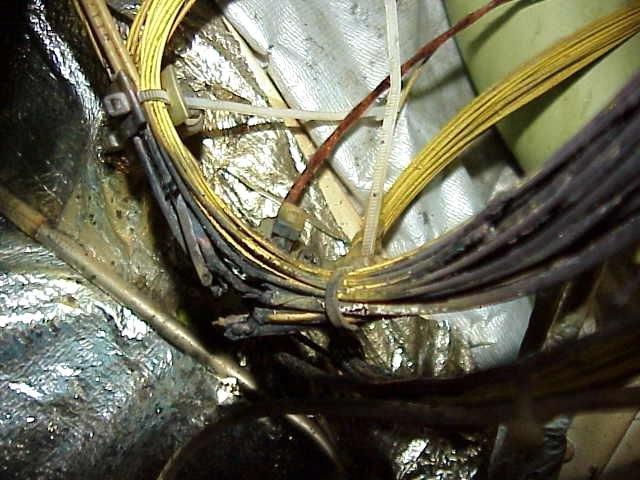
EWIS is not an abstract diagram. It is wiring, connectors, supports, conduits, terminations, bonding paths and protective hardware routed through real aircraft zones. The visual condition of those items matters because a small cut, loose support, contamination path or incorrect repair can become a latent system failure.
Figure 1.2 illustrates the installed wiring discussed below.
Why this training exists
Wiring degradation is frequently subtle. Cracked, chafed or breached insulation — particularly on small-gauge wire and in concealed runs behind structure — is not always visible to the naked eye, and contamination, heat damage and mechanical wear can develop slowly over many years. Service experience showed that relying on incidental or general visual inspection alone was not sufficient to keep ageing wiring safe.
This training therefore exists to raise the awareness and competence of personnel who perform EWIS maintenance and inspection. It deliberately combines two threads: sound visual and detailed inspection technique on one hand, and improved maintenance and installation practices on the other, so that defects are both found earlier and introduced less often.
Who this course is for — Target Groups
The course serves the combined needs of two target groups. You may belong to one or both; the material is presented as a union of what each group needs to know.
| Target group | Who | Typical role |
|---|---|---|
| TG1 | Qualified staff who perform EWIS maintenance | For example, avionics (B2) maintenance technicians repairing and modifying wiring. |
| TG2 | Qualified staff who inspect EWIS | For example, inspectors carrying out maintenance inspections of wiring installations. |
Throughout the course you will see small badges that signal the intended depth for each group. A TG1 badge marks knowledge supporting maintenance duties; a TG2 badge marks inspection-focused content. As an example, the wiring practices material in Appendix A rows 8–12 has objectives for both TG1 and TG2 in the complete organisational programme; this online delivery teaches the supporting knowledge, so that inspectors understand the practices well enough to assess the work even where they do not perform every task themselves.
Regulatory basis
Regulation (EU) 2018/1139 Article 15(2)(a) establishes the organisational-approval framework for maintenance and continuing-airworthiness management, subject to its stated exceptions. Regulation (EU) 1321/2014 Annex II, 145.A.30(e), requires the maintenance organisation to establish and control personnel competence. AMC5 145.A.30(e)(a)–(b) says the organisation should assess particular training needs and points to AMC 20-22 for EWIS training guidance. The implementing rule is binding; AMC describes an acceptable way of complying. An alternative means needs the competent authority's prior approval under 145.A.120. Guidance Material (GM) explains requirements; it is not an alternative means of compliance.
The aircraft-task chain is different: Part-21 21.A.7 requires design approval holders to develop or reference and provide instructions for continued airworthiness (ICA). Where included in the applicable certification basis, CS 25.1729 and Appendix H, H25.5 address EWIS ICA; the AMC to H25.5 describes tasks derived using an Enhanced Zonal Analysis Procedure (EZAP) and separation information. M.A.302(d)(2) addresses ICA in the Aircraft Maintenance Programme (AMP); CAMO.A.315(b)(1) requires the continuing airworthiness management organisation (CAMO) to develop and control that programme. The maintenance organisation then uses applicable current task data under 145.A.45. For example, an ICA cleaning task becomes an AMP task, a work order and a recorded maintenance action.
CS-25 Subpart H runs from CS 25.1701 to CS 25.1731. EASA introduced these EWIS specifications in Amendment 5. For affected existing designs it used Part-21 provisions and regulatory letters, as EASA FAQ 19417 explains. Do not attribute this historical action to EASA Part-26. The separate United States Federal Aviation Administration (FAA) framework includes 14 CFR 26.11. AMC 20-21 addresses enhanced EWIS maintenance, AMC 20-22 training and AMC 20-23 standard wiring practices documentation.
Refresher training: AMC 20-22 §8(b) recommends a period not exceeding two years, reviewing previous material and relevant new material or publication revisions against the target-group programme. This is an AMC recommendation, not a universal certificate-expiry rule. Changed duties or instructions can require earlier training through the organisation's competence process.
Applicability and role
Check the full applicable rule, aircraft certification basis and organisational training needs. A simplified passenger/payload threshold is not a universal exemption from wiring competence or safe maintenance practices. The target group follows actual duties: TG1 performs EWIS maintenance; TG2 performs EWIS inspections without that maintenance role.
How this course works
- The course is delivered in 13 sections, which you complete in order, marking each one done before moving on.
- A score of 75% or higher issues your certificate of completion automatically.
Worked decision — Match training to the actual role
Everyday example. In driving theory and the driving test, explaining a manoeuvre and carrying it out are different evidence.
In a Part-145 hangar, Ari and Bo passed the same online course. Ari is now due to replace a contact on a transport jet. Selecting the correct contact on paper is the driving theory. On the workplace assessment sheet, the assessor records whether Ari can actually prepare the wire, fit the contact and verify its retention using the applicable task. Bo is assigned to inspect wiring and has no repair authorisation. The supervisor checks Bo’s evidence for the assigned inspection duties. Use the job duties to select the target group and check workplace authorisation separately.
Regulatory basis: what this course includes
This course teaches the sources below as amended up to the act or decision shown. Anything published after it is not part of this edition of the course.
| Source | Included up to |
|---|---|
| AMC 20-22 (EWIS training), Target Groups 1 & 2 | AMC-20 Amendment 23 (ED Decision 2022/001/R) (AMC 20-22 unchanged since ED Decision 2008/007/R) |
Checked against the official texts on 2026-11-17. Before relying on a point at work, check the current consolidated text on EUR-Lex and the AMC & GM currently published by EASA, including any later ED Decision.
Match training to the actual role
3 questions · Retry freely · Separate from your final exam
Choose an action, check its consequence and explore the alternatives. Your practice answers are not saved.
Two staff complete the same online knowledge course.
- Ari
- Assigned to repair wiring
- Bo
- Assigned to inspect wiring, with no repair authorisation
Compare all answers and explanations
Ari aligns with TG1; Bo aligns with TG2 — Best choice.
TG1 covers maintenance and TG2 maintenance inspection; map what each person actually does. (AMC 20-22 Appendix A/C; 145.A.30(e).)
Both align with TG1 through proximity to wiring — Consider the consequence.
Being near wiring does not establish that Bo performs EWIS maintenance. (AMC 20-22 Appendix A/C; 145.A.30(e).)
Both align with TG2 through final inspection — Consider the consequence.
Inspection of a repair does not remove Ari’s maintenance duties. (AMC 20-22 Appendix A/C; 145.A.30(e).)
Compare all answers and explanations
Observed contact-repair performance — Consider the consequence.
A screen-based response has not observed those manual actions. (AMC 20-22 Appendix A/C; 145.A.30(e).)
Aircraft-specific inspection competence — Consider the consequence.
A generic course result does not establish completion of that local assessment. (AMC 20-22 Appendix A/C; 145.A.30(e).)
Completion of knowledge and decision training — Best choice.
The result supports knowledge; observed performance supplies different evidence. (AMC 20-22 Appendix A/C; 145.A.30(e).)
Compare all answers and explanations
Select the objectives from the licence category recorded in personnel files — Consider the consequence.
A licence category does not describe every assigned duty. (AMC 20-22 Appendix A/C; 145.A.30(e).)
Compare the actual duties with the relevant matrix objectives — Best choice.
Review each assigned duty, including overlap between groups. (AMC 20-22 Appendix A/C; 145.A.30(e).)
Select the same hands-on objectives for repairers and inspectors — Consider the consequence.
The matrix assigns different practical depth to TG1 and TG2. (AMC 20-22 Appendix A/C; 145.A.30(e).)
Continue with lesson 2: Why EWIS Matters — Background & Lessons Learned
€65 per seat + VAT where applicable
Get the syllabus by email
Not ready to buy? We email you the printable syllabus, the free lesson and the course page.