Free lesson preview: EWIS Group 5 — Initial
EWIS — AMC 20-22 — Target Group 5 — Initial Knowledge Training
Lesson 1 of 7, exactly as learners see it. No sign-in needed; practice answers are not saved.
- 2.5 hours learning
- 12 questions, 18 min
- Certificate at 75 %
Lesson 1 of 7
Planning work around wiring
Learning objective: Identify wiring exposure created by the sequence and packaging of non-electrical work.
Electrical wiring interconnection system (EWIS) means the installed wires and wiring devices transmitting electrical energy, data or signals between intended termination points. CS 25.1701 includes relevant connectors, splices, supports, sleeving, identification and bonding/grounding devices and connections. It has defined exclusions, including fibre optics and certain qualified equipment internals; it is not simply another name for everything electrical.
Why a planner needs this knowledge
A floor-beam repair can damage wiring even when its work card never mentions a circuit. Drills can strike hidden wires; metal particles can penetrate insulation or bridge conductors. Arcing can cause circuit failure, smoke or fire. A clean appearance after the event cannot guarantee that every small insulation breach has been found. Prevention and inspection therefore work together (AMC 20-21 §§8, 11(b); AMC 20-22 §2).
Regulation (EU) 2018/1139 Annex II §3.1 sets the essential organisational requirements for resources and safety management. Regulation (EU) 1321/2014 Annex II, 145.A.30(e), requires Part-145 organisations to establish and control personnel competence. AMC5 145.A.30(e)(a)–(b) says the organisation should assess particular training needs, including EWIS, and points to AMC 20-22. AMC 20-22 §2 describes groups 3–8 as having no direct regulatory requirement for this specific EWIS training model in its stated context. That qualification does not remove the organisation’s competence duties. TG5 covers other engineering, including mechanical/structural design, and maintenance planning; electrical/avionic design is TG3.
Implementing rules impose obligations; AMC gives an acceptable means of compliance, with recommendations expressed as “should”. Guidance Material (GM) explains the rules. An aircraft maintenance programme (AMP), task instruction and organisational procedure then determine the work to be done. For Part-145 planners, 145.A.47(a) requires the necessary people, tools, equipment, materials, data and facilities to be planned.
Syllabus map
AMC 20-22 Appendix B assigns these nine objectives to TG5. Appendix C supplies the teaching detail. The map identifies the knowledge taught here and the aircraft-specific follow-up for damage recognition and bond/ground installation.
| Source row and objective | Lesson and teaching heading | Level |
|---|---|---|
| 13. Plan the correct inspection type, criteria, conditions and resources. | Lesson 2: Inspection scope, visibility and escalation — Inspection type, criteria and resources | knowledge |
| 14. Control fatigue, expectation, interruptions and inspection handovers. | Lesson 3: Human factors in inspection planning — Fatigue, interruption and coverage handover | knowledge |
| 15. Relate zonal inspection boundaries to systems and local exposures. | Lesson 3: Human factors in inspection planning — Zonal context and inspection boundaries | knowledge |
| 16. Recognise chafing, crushing, corrosion, heat damage and contamination, and describe the finding. | Lesson 5: Zonal damage and bonding interfaces — Damage mechanisms at engineering interfaces | knowledge |
| 20. Plan protection, resources, ownership and work dependencies. | Lesson 1: Planning work around wiring — Work sequence, protection and hold points | knowledge |
| 21. Keep protection effective throughout maintenance and repair. | Lesson 1: Planning work around wiring — Work sequence, protection and hold points | knowledge |
| 22. Plan the permitted cleaning method, access and checks needed before closure. | Lesson 4: Protection and contamination by design — Cleaning method, access and completion evidence | knowledge |
| 27. Recognise typical damage and relate it to the aircraft’s installation and environment; complete aircraft-specific recognition training locally. | Lesson 5: Zonal damage and bonding interfaces — Damage mechanisms at engineering interfaces | knowledge |
| 31. Explain bond and ground functions, recognise defects, and plan restoration and verification; complete aircraft-specific installation training locally. | Lesson 5: Zonal damage and bonding interfaces — Bonding and grounding work-package interfaces | knowledge |
Work sequence, protection and hold points
Start with the physical zone, aircraft configuration and adjacent systems. A hold point is a planned stop: specified checks must be accepted before the next activity, such as panel closure, proceeds.
| Stage | What the package must provide |
|---|---|
| Prepare access | Energy controls, lighting and platforms; identify hidden wiring and existing damage. |
| Protect before work | Cover or remove exposed wiring as the instructions require; assign installation and checking of barriers and debris capture. |
| Work and clean progressively | Maintain protection, remove accumulating debris and hand over its custody. Reassess unexpected exposure. |
| Restore and inspect | Remove and account for temporary protection, clean the affected area, restore displaced wiring and perform the required examinations after the last disturbance. |
| Close access | Check completion of the linked tasks and remaining findings before accepting the hold point. |
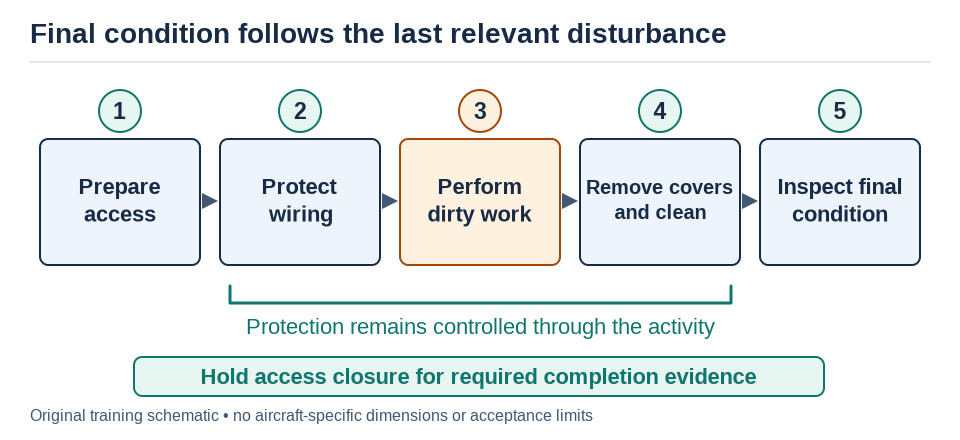
Everyday example. Cleaning a room before more sanding still counts as cleaning. The final check must follow the last dusty activity.
At a Part-145 base check on a passenger jet, the planner sees a wiring inspection signed at 10:00 and a drilling card added at 11:00 for the floor support above the harness. The added drilling is the extra sanding. Figure 1.2 shows where to schedule the fresh inspection. The planner retains the earlier inspection record and adds work for the new exposure. The pack specifies protection before drilling and cleaning during the work, then final cleaning and a fresh inspection before panel closure.
AMC 20-21 Appendix E recommends cleaning during work, thorough cleaning afterwards and inspection after final cleaning.
Plan boards or platforms to support people and tools. A harness is neither a handhold nor a support for a lamp. Pulling a clamped bundle aside can damage insulation. Where movement is necessary, include the specified release from restraints, safe displacement, restoration of its normal configuration and examination. AMC 20-21 §11(a), (b), (k) supplies this guidance.
Worked example: reopening a completed bay
A bay inspection is complete when a late bracket job needs access behind a harness. The planner identifies both tool contact and debris exposure, adds the necessary wiring release/protection and restoration tasks, and holds closure for cleaning and inspection after the bracket work. The final package links those records to the bracket card; it preserves the original inspection record as evidence of the earlier condition.
Case: Keep follow-up work open until it is complete
- Date and place
- 2013-03-01, stand 25, London Gatwick Airport
- Aircraft
- Twin-engine passenger jet (G-CELS)
- Outcome
- Minimal damage around the connector. No injuries.
- Investigation
- AAIB, EW/C2013/03/01 (published 2013-12-12)
What happened
The crew were preparing for a ferry flight when they lost electrical ground power. They resumed preparations after the power was restored. The senior cabin crew member then reported smoke and sparks near an overhead locker. The flight crew told the cabin crew to leave, carried out the quick reference handbook drills and declared a mayday before leaving the aircraft.
What the investigation found
The operator’s engineers traced the smoke and sparks to arcing across the pins of the connector that had powered the removed No 2 galley. Tests found voltage at the connector with the galley circuit breaker pulled and collared. A fleet inspection under a 2012 Line Maintenance Work Request had found the connector live on this aircraft. The work-request system allowed closure without confirmation that follow-up work was complete. The operator changed the system to require completion of that work before closure.
What it teaches
For a planner, the work request needs to show both what the inspection established and how the finding was resolved. Where closure depends on follow-up, link that work to the inspection and identify the evidence required at the hold point.
At work: Before closing an inspection request, check that each linked action has its required completion record.
Source: AAIB, Smoke in the cabin during pre-flight preparation (EW/C2013/03/01), published 2013-12-12.
Regulatory basis: what this course includes
This course teaches the sources below as amended up to the act or decision shown. Anything published after it is not part of this edition of the course.
| Source | Included up to |
|---|---|
| AMC 20-22 (EWIS training), Target Group 5 | AMC-20 Amendment 23 (ED Decision 2022/001/R) (AMC 20-22 unchanged since ED Decision 2008/007/R) |
Checked against the official texts on 2026-11-17. Before relying on a point at work, check the current consolidated text on EUR-Lex and the AMC & GM currently published by EASA, including any later ED Decision.
Case source: AAIB, Smoke in the cabin during pre-flight preparation (EW/C2013/03/01), Bulletin 12/2013, pp. 13–14, published 2013-12-12.
Application: Planning work around wiring
3 questions · Retry freely · Separate from your final exam
Choose an action, check its consequence and explore the alternatives. Your practice answers are not saved.
A check combines floor repair, cable inspection and cabin cleaning. The draft sequence inspects the wiring first, drills the floor supports next, then closes the panels before cleaners arrive.
- Role
- Other engineering and maintenance-planning staff working on in-service aeroplanes
- Learning objective
- Identify wiring exposure created by the sequence and packaging of non-electrical work.
- Planning facts
- Drilling follows the initial wiring inspection; panel closure precedes cleaning.
Compare all answers and explanations
The drilling can alter the wiring condition after its initial inspection. — Best choice.
Correct. The earlier inspection describes an earlier condition; provide protection, cleaning and further examination after the disturbance. AMC 20-21 §11(b), Appendix E.
The panel closure establishes the final wiring condition before cleaning. — Consider the consequence.
Panel closure does not establish physical cleanliness or integrity. The required cleaning and inspection need access.
The floor-repair inspection covers the wiring exposed during the drilling. — Consider the consequence.
The structural inspection and the affected wiring checks have distinct scope. Drilling particles can lodge in wiring.
Compare all answers and explanations
Assign removal to the closing team, with installation checks left to each trade. — Consider the consequence.
Removal ownership leaves installation and intermediate monitoring unclear; all stages need to be allocated.
Assign each trade its own cover check, with final removal left to the next shift. — Consider the consequence.
The next shift needs an explicit removal responsibility, not an assumption inherited from another trade.
Assign installation, checks, handover and removal to named people in the package. — Best choice.
Correct. Cover custody must survive the shift change and its removal must be accounted for. AMC 20-21 §11(b); 145.A.47(c), 145.A.48(c)(1).
Compare all answers and explanations
Review structural inspection and labour, retaining the existing wiring closeout. — Consider the consequence.
That review misses the new debris and tool exposure to wiring. The previous closeout describes the earlier condition.
Review wiring exposure, protection, sequence, access and the final examination needed. — Best choice.
Correct. Reassess the affected work and schedule the further protection, cleanup and examination. AMC 20-21 §11(b); 145.A.47(a).
Review access and the final operational test, carrying forward the wiring-inspection record. — Consider the consequence.
An operational test does not establish physical cleanliness or the absence of insulation damage after drilling.
Continue with lesson 2: Inspection scope, visibility and escalation
€55 per seat + VAT where applicable
Get the syllabus by email
Not ready to buy? We email you the printable syllabus, the free lesson and the course page.