EASA Part-145 Regulations — Initial
Free lesson preview: EASA Part-145 Regulations — Initial
EASA Part-145 Regulations Initial Training
Lesson 1 of 16, exactly as learners see it. No sign-in needed; practice answers are not saved.
- 6 hours learning
- 12 questions, 18 min
- Certificate at 75 %
Lesson 1 of 16
How to read the Part-145 rule set
Learning objective: Tell implementing rules, AMC, GM, the MOE and EASA FAQs apart, and identify the amendments since the 2025-09 Easy Access Rules that change what a Part-145 organisation must apply.
This lesson shows which documents you need, what authority each has and how to check whether it is current. The course is knowledge training: passing it records what you learned and does not grant an organisation approval, a certification authorisation or a finding of competence. Those are decided by your organisation and the competent authority under their own rules.
Where Part-145 sits
Part-145 is Annex II to Commission Regulation (EU) No 1321/2014 on continuing airworthiness. The cover regulation starts with its Articles (scope, definitions, which annex applies to which aircraft, organisation approvals, certifying staff, transition and entry into force) and then carries eight technical annexes, usually called Parts: Annex I Part-M, Annex II Part-145, Annex III Part-66, Annex IV Part-147, Annex Va Part-T, Annex Vb Part-ML, Annex Vc Part-CAMO and Annex Vd Part-CAO.
Two administrative annexes complete the regulation: Annex V lists the repealed Regulation (EC) No 2042/2003 and its amendments, and Annex VI is the correlation table. Part-145 itself has a Section A for the organisation and a Section B for the competent authority, followed by four binding appendices.
The rules reach you through a fixed institutional chain. EASA supports Union aviation rulemaking and issues Opinions containing proposed rules. Under the Basic Regulation, the European Commission adopts the applicable delegated or implementing regulations, and publication in the Official Journal of the European Union is the legal publication. EASA Executive Director Decisions adopt AMC and GM and, where relevant, certification specifications (CS). EASA does not issue Commission regulations.
Five kinds of text, five different jobs
The implementing rule (for example 145.A.40) is the law: the organisation must meet it. Acceptable means of compliance (AMC) show one way to meet the rule that the authority accepts. GM1 145.A.120 states that AMC are not legally binding but that applying them is recommended. An organisation that wants to meet the rule another way uses an alternative means of compliance, and under 145.A.120(b) it must give the competent authority a full description and obtain prior approval before using it. Guidance material (GM) explains and illustrates; it adds no obligation of its own.
The maintenance organisation exposition (MOE) is the organisation's own description of how it complies. Once the authority has approved it (145.A.70(b)), 145.A.20(b) obliges the organisation to work within its terms of approval and the scope of work in the MOE, so an MOE procedure binds the people of that organisation even where the rule allows other methods. EASA FAQs are dated answers to common questions. They help interpretation and can change at any time, so you record the date you read them and still decide from the rule text.
Fictional example: the tool controller at Example Aero Services Ltd, a Part-145 maintenance organisation in Zedland (ZZ), uses MOE 2.4 revision 6 to check torque wrench AV-TW-17 before issuing it for a narrow-body twin-jet actuator installation. The rule, 145.A.40(b), requires suitable control and calibration. The AMC describes an accepted way to set the interval; the approved MOE specifies this wrench’s interval and issue checks. When the calibration label and register disagree, the controller holds the wrench and resolves the discrepancy before issue. Start with the applicable rule, check the AMC method, then follow the organisation’s approved procedure.
Reading the Easy Access Rules colours and source notes
EASA's Easy Access Rules (EAR) put the cover regulation, the implementing rules, the AMC and the GM in one document. The editor's key colours implementing rules blue, AMC amber and GM green, and an italic note under each heading names the regulation or ED Decision that introduced or last amended that item. Figure 1.2 shows the key; Figures 1.3 to 1.5 show the three headings for 145.A.10.
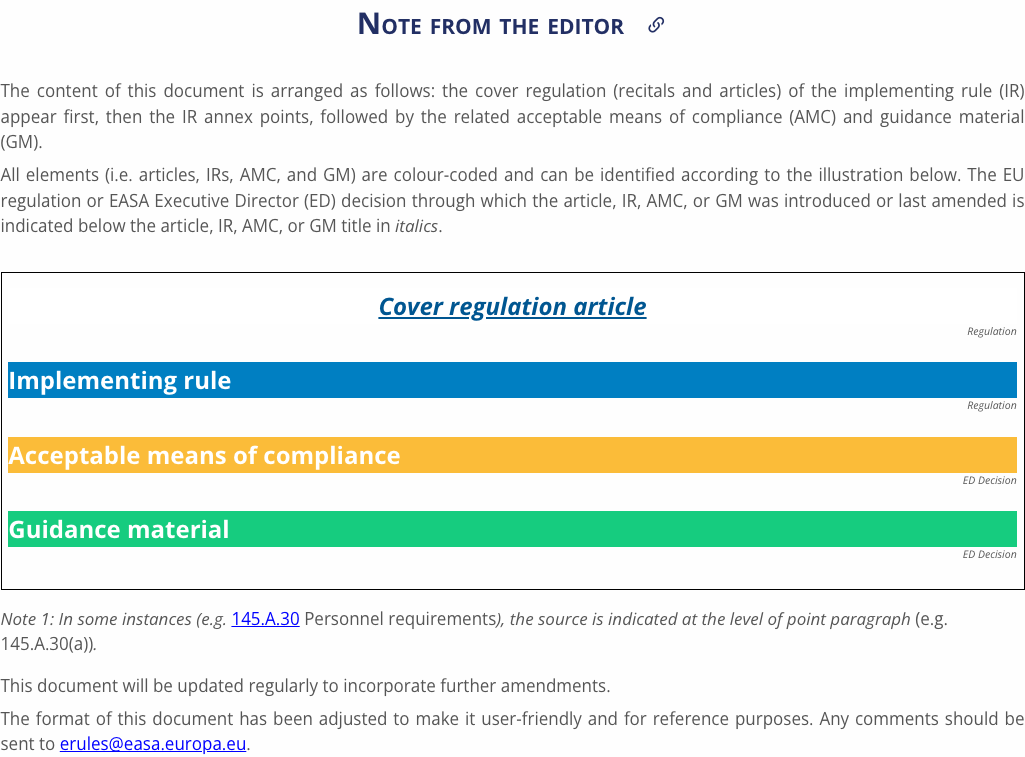



Figure 1.5 is a useful warning. The 2025-09 EAR still shows ED Decision 2022/011/R under GM1 145.A.10, but ED Decision 2026/002/R, signed 2026-01-30 and published 2026-02-03, has since amended that GM. A screenshot or a printout tells you what the text was on the day it was made, not what it is today.
Regulatory basis: what this course includes
This course teaches the sources below as amended up to the act or decision shown. Anything published after it is not part of this edition of the course.
| Source | Included up to |
|---|---|
| Regulation (EU) No 1321/2014 — Articles and Annex II (Part-145) | Implementing Regulation (EU) 2026/100 (applicable from 2026-08-07) |
| Implementing Regulation (EU) 2015/1018 (occurrence lists) | Implementing Regulation (EU) 2026/1821 (applicable from 2026-08-17) |
| AMC & GM to the Articles of Regulation (EU) No 1321/2014 | ED Decision 2026/002/R (Issue 1, Amendment 4) |
| AMC & GM to Part-145 | ED Decision 2026/005/R (Issue 2, Amendment 9) |
Checked against the official texts on 2026-11-17. Before relying on a point at work, check the current consolidated text on EUR-Lex and the AMC & GM currently published by EASA, including any later ED Decision.
Related sources: the reporting, security and design interfaces
The main table identifies the Part-145 rule set. These related sources govern the reporting, security and component decisions taught later. The same course cut-off applies: this edition does not include later amendments.
| Related source | Included edition and use |
|---|---|
| Regulation (EU) No 376/2014 | As amended by Regulation (EU) 2018/1139; consolidated 2018-09-11. Lessons 8 and 11 use Articles 4, 13 and 16. |
| Implementing Regulation (EU) 2015/1018 | As amended by Implementing Regulation (EU) 2026/1821, applicable 2026-08-17. Lessons 8, 12 and 15 use the maintenance occurrence list. |
| Implementing Regulation (EU) 2023/203 | As amended by Implementing Regulation (EU) 2025/2293; consolidated 2026-02-22. Lesson 12 uses Articles 2, 12 and 16 and Part-IS.I.OR. |
| Regulation (EU) No 748/2012 | Part-21 and Part 21 Light, including the applicable 2026/56 and 2026/100 amendments from 2026-08-07. Lessons 6, 7, 13 and 15 use parts eligibility, identification and repair-data provisions. |
For live work, open the specific provision and check later acts and the applicable aircraft data. A reference here defines this edition's coverage; it does not make every design-data route available to every aircraft.
Use the application date for each provision
Being in the compilation is not the same as being applicable. Point 145.A.200A (information security management system) and the authority points 145.B.125(c), 145.B.135A and 145.B.330A were inserted by Implementing Regulation (EU) 2023/203; EASA incorporated that Regulation in its 2024-07 revision of the Easy Access Rules, so they appear in the 2025-09 compilation, each marked "Applicable from 2026-02-22". They have applied only since that date (lesson 12).
Notice the three dates. Publication in the Official Journal fixes the official text; entry into force (here the twentieth day after publication) brings the act into force; the application date is when the provision starts to apply. Regulation 2026/100 shows why each provision needs its own entry: most of it applies from 2026-08-07, but its correction to Article 5(8) applies from 2026-02-13 and its correction to Part-CAMO from 2026-02-22.
At work: checks before your next decision
At work: Before changing an MOE method, identify the rule, the accepted method and the procedure currently approved for your organisation. Use the regulatory-basis table to identify the course edition, then check official publications for the live decision. If your proposed method departs from AMC, prepare the full compliance explanation and obtain the required prior approval before use.
An out-of-date library copy
3 questions · Retry freely · Separate from your final exam
Choose an action, check its consequence and explore the alternatives. Your practice answers are not saved.
Fictional training example — Example Aero Services Ltd, Zedland (ZZ), specimen approval ZZ.145.0417. On 2026-11-12 a compliance monitoring engineer is updating the component shop’s regulatory library. The shelf copy of the rules is the 2025-09 Easy Access Rules for Continuing Airworthiness. A planner has just used it to check the 145.A.30(h) staffing rule, and a colleague wants to replace the AMC method described in the MOE with a quicker method he prefers.
- Source references
- Regulation (EU) No 1321/2014; 145.A.30; 145.A.120; Regulation (EU) 2025/111
Compare all answers and explanations
The act that last amended the item before the compilation's cut-off; later changes may be missing. — Best choice.
Correct. The note records the item's history up to the compilation's cut-off. GM1 145.A.10 is an example: the 2025-09 note shows 2022/011/R, but ED Decision 2026/002/R has amended it since.
The act that currently governs the item, because a compilation is reissued whenever a rule changes. — Consider the consequence.
Compilations are reissued periodically, not with every amendment. EASA itself states that the 2025-09 revision does not include Regulation (EU) 2025/111, so the note can be out of date.
The date from which the item applies to the organisation, which is the date shown in the note. — Consider the consequence.
The note names a regulation or ED Decision, not an application date. Application dates come from the amending act itself, and they can differ between its provisions.
Compare all answers and explanations
Yes, because a consolidated EASA compilation is the legal text of the Regulation. — Consider the consequence.
The legal text is the Regulation as published in the Official Journal. A compilation is a reading aid, and this one predates an amendment to the very point being used.
Yes, provided the printout was issued by EASA and is less than two years old. — Consider the consequence.
Age and publisher do not decide currency. What matters is whether any amendment applies after the compilation's cut-off, and here one does.
No: Regulation 2025/111 changed 145.A.30(h)(2)(ii) and EASA states the compilation does not include it. — Best choice.
Correct. From 2026-02-13, 145.A.30(h)(2)(ii) allows category C or L5 staff with support staff. The planner must use the amended text.
Compare all answers and explanations
A full description to the authority and its prior approval as an alternative means. — Best choice.
Correct. Under 145.A.120(b) the organisation describes the alternative, including manual changes and how compliance is achieved, and uses it only after prior approval. The MOE then lists it under 145.A.70(a)(17).
An MOE amendment under the procedure for changes not requiring prior approval, then immediate use. — Consider the consequence.
The indirect change procedure cannot be used to bypass 145.A.120(b). Using a means other than the AMC needs the authority's prior approval first.
Nothing, because AMC is not legally binding and the organisation may choose any method. — Consider the consequence.
AMC is not binding, but the alternative must still be shown to comply and approved before use under 145.A.120(b). Choosing freely without that step is a non-compliance.
Sources checked 2026-11-17. Regulation (EU) No 1321/2014, applicable Articles and Part-145 provisions cited in this lesson; ED Decision 2026/002/R, signed 2026-01-30, published 2026-02-03.; Regulation 376/2014 through 2018/1139.; Regulation 748/2012, 2026-08-07 consolidation.; Regulation 2023/203 through 2025/2293.
Continue with lesson 2: Regulation 1321/2014: Articles, annexes and the competent authority
€65 per seat + VAT where applicable
Get the syllabus by email
Not ready to buy? We email you the printable syllabus, the free lesson and the course page.