EASA Part-66 & Part-147 Regulations — Initial
Free lesson preview: EASA Part-66 & Part-147 Regulations — Initial
EASA Part-66 and Part-147 Regulations Initial Training
Lesson 1 of 18, exactly as learners see it. No sign-in needed; practice answers are not saved.
- 6 hours learning
- 12 questions, 18 min
- Certificate at 75 %
Lesson 1 of 18
How Part-66 and Part-147 are published and kept current
This course teaches Annex III (Part-66) and Annex IV (Part-147) to Commission Regulation (EU) No 1321/2014. Part-66 tells a person how to obtain, keep and use an aircraft maintenance licence (AML). Part-147 tells an organisation how to be approved to train and examine those people. The course is written for licence applicants and holders, for Part-145 and Part-CAO staff who check licences before issuing certification authorisations, and for the staff of Part-147 maintenance training organisations.
What the course is, and is not. It records assessed regulatory knowledge. It is not approved aircraft type training, not a Part-66 basic-knowledge module examination, not a practical assessment and not on-the-job training (OJT), and its completion certificate is not a Certificate of Recognition (EASA Form 148 or 149). It does not grant a licence, a rating or a certification authorisation. Where the current law or your competent authority says something different from this course, they prevail.
The estimated learning time shown for this course is calculated from its lessons, practice decisions and timed final exam using the method on the Quality and records page. Each of the 18 lessons ends with three ungraded practice decisions: 54 decisions in total.
The twelve-question final examination allows 18 minutes (90 seconds per question). It draws from a 52-question bank. You need nine correct answers to reach 75 %. Aviocourse chose this timing and pass mark for its regulatory-knowledge assessment. Appendix III uses the same nominal 90-second average for type-training theory examinations; Appendix II uses 75 seconds for basic-module multiple-choice examinations. This course's exam is neither of those approved examinations.
All unnamed or invented people, organisations, documents and aircraft in the worked examples and practice decisions are fictional. Example Aero Services Ltd (ZZ.145.0417) and Example Aviation Training Ltd (ZZ.147.0012) are in fictional Zedland (ZZ). Where an example needs a Member State authority, Zedland stands in for one solely for this exercise; it is not a real EASA approval or recognition claim.
Who makes the rules
The Basic Regulation is Regulation (EU) 2018/1139. Article 16 establishes the licensing requirement for people releasing products or parts after maintenance, subject to the exceptions provided through implementing acts. Article 17(1)(b) covers organisation approvals, (d) covers licences, and (e) covers holders’ privileges and responsibilities. Part-147 (approvals) and Part-66 (licences) are those rules. EASA supports rulemaking through technical work and opinions: Regulation (EU) 2025/111, for example, states that it is based on EASA Opinion No 04/2024.
Acting under the Basic Regulation, the European Commission adopts the applicable delegated or implementing regulation; publication in the Official Journal of the European Union is its legal publication. EASA Executive Director Decisions separately adopt AMC and GM or Certification Specifications.
| Text | Who adopts it | How to read it | Example in this course |
|---|---|---|---|
| Implementing rule (IR): the points of Part-66 and Part-147 and their appendices | European Commission, published in the Official Journal | Binding law. "Shall" means you must. | 66.A.20(b)(2): no use of privileges without 6 months of maintenance experience in the preceding 2 years (or having met the provisions for the issue of those privileges). |
| Acceptable means of compliance (AMC) | EASA Executive Director Decision | A non-binding standard: one accepted way of meeting the rule. "Should". | AMC 66.A.20(b)(2): the 6 months may be replaced by 100 days of maintenance experience. |
| Guidance material (GM) | EASA Executive Director Decision | Non-binding explanation and examples. It creates no obligation on its own. | GM1 66.A.20(a): what a "simple test" is. |
| Easy Access Rules (EAR) | EASA, as a consolidated reading copy | A convenient compilation with a cut-off date. It has no legal force of its own. | The 2025-09 continuing-airworthiness revision. |
| EASA FAQ | EASA website | An explanation of a recurring question. It does not amend the rule or decide your case. | FAQ 139284 on Part-IS and Part-66 (lesson 16). |
Record how the organisation meets the rule
ED Decision 2026/002/R itself restates the weight of its own content: its recitals call AMC "non-binding standards" and GM "non-binding material". Using another method is possible, but it is not a private decision. In Part-66, 66.B.2 allows alternative means of compliance and requires the competent authority to inform EASA of those used by persons under its oversight. Part-147 has no separate alternative-means point; a training organisation that departs from an AMC still has to show its competent authority how its method meets the rule, because its procedures must be acceptable to that authority (147.A.130(a)) and its exposition is approved by it (147.A.140(b)).
If a company adopts the AMC’s 100-day method, label it as the company’s AMC-based procedure. Staff follow that adopted procedure; its use does not turn the AMC into legislation. The binding rule remains six months in the preceding two years, or meeting the requirements for issue of the privileges. A Part-147 organisation proposing a different method must show its authority how its procedures meet the rule.
Easy Access Rules: a reading copy with a cut-off
The Easy Access Rules for Continuing Airworthiness combine Regulation (EU) No 1321/2014 with its AMC and GM. The current revision was published on 2025-09-10, and the EASA page states that Regulation (EU) 2025/111 is not incorporated and will be included in a later revision. Nothing adopted after the cut-off can be in it either, which includes Regulation (EU) 2026/100 and ED Decision 2026/002/R. In practice this means that the 2025-09 book contains no B1.E subcategory, no subgroup 2E and no Module 18, although all three have applied since 2026-02-13.
The book is colour-coded, and under every heading an italic source note names the regulation or ED Decision that last introduced or amended that item. Figure 1.1 shows the key. Figures 1.2 to 1.4 show three headings for one Part-145 point, chosen because they show all three colours together.
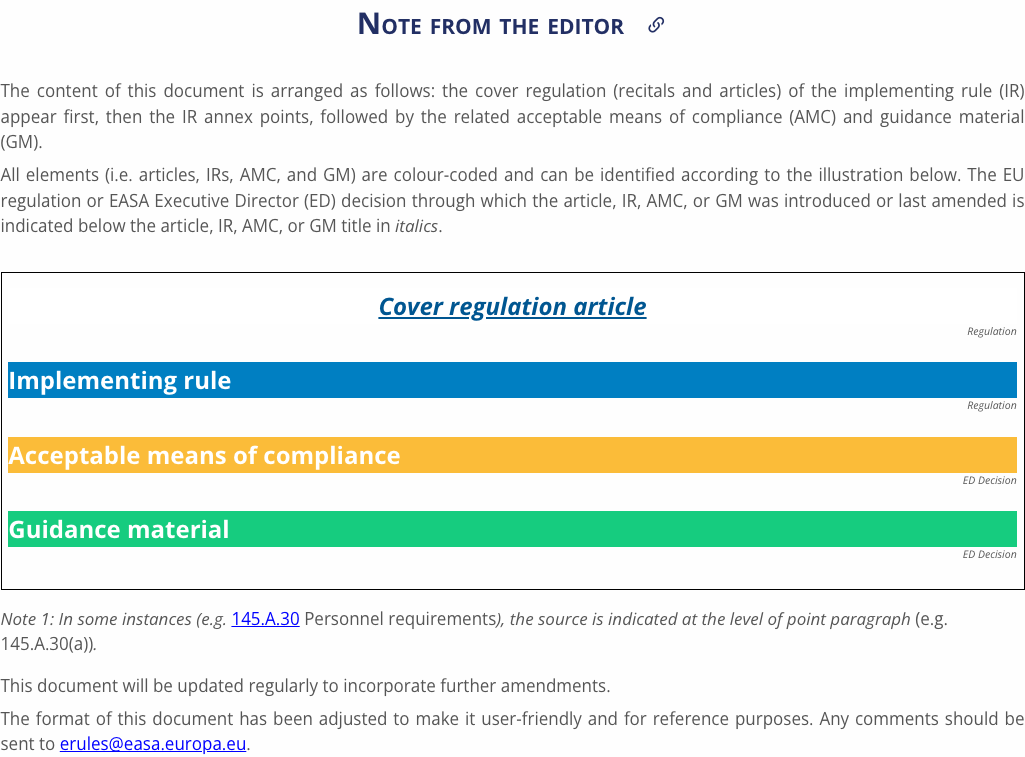



Figure 1.4 is the reason for the routine below. A source note tells you the last amendment the compilation knows about, not the last amendment that exists. ED Decision 2026/002/R is dated 2026-01-30, was published on 2026-02-03 and, under its Article 2, entered into force on the day after publication, 2026-02-04. A compilation printed in 2025-09 cannot show it.
Regulatory basis: what this course includes
This course teaches the sources below as amended up to the act or decision shown. Anything published after it is not part of this edition of the course.
| Source | Included up to |
|---|---|
| Regulation (EU) No 1321/2014 — Articles, Annex III (Part-66) and Annex IV (Part-147) | Implementing Regulation (EU) 2026/100 (applicable from 2026-08-07) |
| AMC & GM to the Articles of Regulation (EU) No 1321/2014 | ED Decision 2026/002/R (Issue 1, Amendment 4) |
| AMC & GM to Part-66 | ED Decision 2026/002/R (Issue 2, Amendment 9) |
| AMC & GM to Part-147 | ED Decision 2026/002/R (Issue 2, Amendment 4) |
Checked against the official texts on 2026-11-17. Before relying on a point at work, check the current consolidated text on EUR-Lex and the AMC & GM currently published by EASA, including any later ED Decision.
The five-minute source check
Before a licensing or training decision, write a short source-check record.
- Identify the decision
Name the person or organisation, the aircraft and the intended privilege. Nadia is checking a B1.E licence entry for her Part-145 employer.
- Read the complete requirement
Start with the cover regulation and its Articles. Then read the relevant Part-66 or Part-147 point, including its exceptions.
- Record the dates
List the base regulation and incorporated amendments. Separate entry into force from the application date relevant to your decision.
- Check for newer material
Search EUR-Lex and EASA’s decisions register after the compilation’s cut-off. One act can have several application dates.
- Label the source
Mark each source as rule, AMC, GM or FAQ. Keep the link, version and date checked with your decision.
A worked example shows why the routine matters. On 2026-10-12, Nadia, the technical-records lead at Example Aero Services Ltd’s Part-145 line station is asked whether a new licence entry "B1.E" on a colleague's licence is genuine. The 2025-09 Easy Access Rules on her desk list B1.1, B1.2, B1.3 and B1.4 only. The routine takes her to Regulation (EU) 2025/111 on EUR-Lex, which inserted B1.E (aeroplanes with electric power plant and MTOM below 5 700 kg) into 66.A.3(a)(2) and applies from 2026-02-13.
The subcategory exists in the applicable rule. She still checks that the issuing authority made the entry and that it matches its records; an unfamiliar label alone proves neither validity nor forgery.
| Field | Entry |
|---|---|
| Licence entry | B1.E; electric aeroplanes below 5 700 kg MTOM |
| Rule and amendment | 66.A.3(a)(2); Regulation (EU) 2025/111 |
| Application date | 2026-02-13 |
| Decision | The subcategory exists. Verify this individual licence entry with the issuing authority before relying on it. |
Record the source before deciding
At work: For Nadia’s B1.E licence check, record the licence entry, issuing authority, rule point, amendment and application date. Keep the source link with the check. If the entry still cannot be reconciled, ask the issuing authority before the organisation relies on it.
A B1.E question answered from last year's book
3 questions · Retry freely · Separate from your final exam
Choose an action, check its consequence and explore the alternatives. Your practice answers are not saved.
On 2026-10-12, Nadia, the technical-records lead at fictional Example Aero Services Ltd (ZZ.145.0417), is writing a briefing on licence checks. Her only reference is the 2025-09 Easy Access Rules PDF. A colleague's new licence shows subcategory B1.E, and the training manager wants the company procedure to say that certifying staff 'shall' have 100 days of experience in every 2 years.
- Source boundary
- Regulation (EU) 2018/1139 Articles 16 and 17; Regulation (EU) No 1321/2014; ED Decision 2026/002/R; 66.B.2; 147.A.130(a); Easy Access Rules September 2025
Compare all answers and explanations
B1.E is a proposal in an EASA Opinion and becomes law only when the next revision of the book is published. — Consider the consequence.
The Easy Access Rules are a reading copy. Law is made by publication of the regulation in the Official Journal, not by a later compilation.
Regulation (EU) 2025/111 created B1.E from 2026-02-13; the book predates it and must be overlaid. — Best choice.
The EASA page for the 2025-09 revision says 2025/111 is not incorporated. B1.E has been in 66.A.3(a)(2) since 2026-02-13.
B1.E is only guidance until EASA adopts AMC and GM for aeroplanes with electric power plant, so the book is complete. — Consider the consequence.
B1.E is in the implementing rule itself. AMC and GM support a rule; they are not needed to bring it into force.
Compare all answers and explanations
As the 66.A.20(b)(2) requirement that every certifying engineer must meet, since the Easy Access Rules print it beside the rule. — Consider the consequence.
The rule says 6 months in the preceding 2 years. The 100 days comes from AMC 66.A.20(b)(2), an accepted means of meeting it; printing them together does not change their status.
As guidance material, which the organisation may ignore without recording a reason. — Consider the consequence.
It is AMC, not GM, and a procedure that adopts it should say so; ignoring the rule itself is never an option.
As the company’s chosen AMC-based method for meeting the rule’s six-month experience requirement. — Best choice.
The 100-day method is AMC. Adopting it in a company procedure does not turn it into legislation. Staff follow the adopted procedure; a different method must still meet the rule through the applicable authority arrangements.
Compare all answers and explanations
GM1 145.A.10 was amended by ED Decision 2026/002/R from 2026-02-04, which the 2025 book cannot show. — Best choice.
A source note shows the last amendment the compilation knows about. ED Decision 2026/002/R came later.
Source notes name the regulation, never the ED Decision, so the note must be a printing error. — Consider the consequence.
AMC and GM headings carry the ED Decision that last introduced or amended them; that is the convention shown in Figure 1.1.
Nothing: a source note on an official EASA publication shows the latest amendment by definition. — Consider the consequence.
It shows the latest amendment included in that compilation. Anything after the cut-off is missing.
Sources checked 2026-11-17. Regulation (EU) No 1321/2014, consolidated 2026-08-07, applicable cover Articles and Annexes III (Part-66) and IV (Part-147). ED Decision 2026/002/R and its Part-66/Part-147 amendments. Basic Regulation, Articles 16 and 17. Specific rule and guidance references appear in the lesson.
Continue with lesson 2: Regulation (EU) No 1321/2014: cover Articles and the 2025–2026 amendments
€75 per seat + VAT where applicable
Get the syllabus by email
Not ready to buy? We email you the printable syllabus, the free lesson and the course page.