EASA Part-CAMO Regulations — Initial
Free lesson preview: EASA Part-CAMO Regulations — Initial
EASA Part-CAMO Regulations Initial Training
Lesson 1 of 17, exactly as learners see it. No sign-in needed; practice answers are not saved.
- 6 hours learning
- 12 questions, 18 min
- Certificate at 75 %
Lesson 1 of 17
Where Part-CAMO is published and how to keep it current
This course is for people who work in, or are preparing to work in, a continuing airworthiness management organisation (CAMO): planners, technical services engineers, nominated persons, compliance monitoring and safety staff, and candidates for airworthiness review staff. It covers Annex Vc (Part-CAMO) to Regulation (EU) No 1321/2014, its AMC and GM, and the points of Part-M, Part-ML, Part 21, Part-IS and Regulation (EU) No 376/2014 that a CAMO uses every day.
Passing the final exam records that you have learned this material. It is not an approval, an authorisation or a finding of competence; those come from your competent authority and your own organisation.
Every lesson cites the point it relies on. Before we study any rule, this opening lesson explains where the rules are published, which version is binding and how to check that the text in front of you is still the current one.
Who writes what
EASA supports rulemaking and issues opinions to the European Commission. Under Regulation (EU) 2018/1139 (the Basic Regulation), the European Commission adopts the applicable delegated and implementing regulations, and publication in the Official Journal of the European Union is their legal publication. EASA Executive Director Decisions adopt acceptable means of compliance and guidance material, and certification specifications where relevant. So Part-CAMO is a Commission regulation, not an EASA regulation, even though EASA drafted the opinion behind it. Regulation (EU) 2026/100, for example, states that its measures are in accordance with EASA Opinion No 08/2024.
Regulation (EU) No 1321/2014 has a cover regulation of Articles 1 to 8 (with an Article 7a) followed by annexes: Annex I is Part-M, Annex II Part-145, Annex III Part-66, Annex IV Part-147, Annex Va Part-T, Annex Vb Part-ML, Annex Vc Part-CAMO and Annex Vd Part-CAO. Each annex has a Section A for the organisation or person and a Section B for the competent authority. A reference therefore names the instrument and the point: CAMO.A.305, M.A.302 or Part-M Appendix I, never just "the regulation says".
Binding rule, AMC and GM
| Layer | Who adopts it | How to read it |
|---|---|---|
| Implementing rule (IR), e.g. CAMO.A.310 | European Commission, published in the Official Journal | Binding. Written with "shall". |
| Acceptable means of compliance (AMC), e.g. AMC1 CAMO.A.310(d) | EASA, by ED Decision | One accepted way to comply, written with "should". A different way is possible, but only through the alternative-means process in CAMO.A.120 (Lesson 4). |
| Guidance material (GM), e.g. GM1 CAMO.A.125(e) | EASA, by ED Decision | Explains the rule. Creates no obligation of its own. |
Keep the label exactly as published when you cite it. "AMC1 CAMO.A.305(a)(3)" lets the next reader open the same text and check whether it supports your conclusion. Throughout this course, when a statement comes from AMC or GM rather than from the rule itself, it says so.
Three dates on every amending act
An amending regulation has a publication date, an entry into force date and one or more application dates, and they answer different questions. Regulation (EU) 2026/100 was adopted on 2026-01-15, published in the Official Journal on 2026-01-19 and entered into force on the twentieth day after publication, 2026-02-08. Under its Article 4 it applies from 2026-08-07, except Article 3(1), which applies from 2026-02-13, and Article 3(2), which applies from 2026-02-22.
The new Part-CAMO wording therefore became the text you must work to on 2026-08-07, not in January when it was published. Always match the application date to the specific provision you are using.
Easy Access Rules: a convenient reprint with a date on it
The Easy Access Rules (EAR) combine rules, AMC and GM in a readable compilation. They are a reading aid rather than the legal publication, and their incorporated amendments stop at a stated cut-off. Compare that cut-off with the amending acts and ED Decisions for the provision you need; a recently downloaded file can still contain earlier wording.
For example, a technical services engineer at fictional Example CAMO Ltd is revising CAME procedure AV-REC-02 for a regional turboprop fleet. Her saved EAR displays an earlier source note for CAMO.A.220. She opens the later amending act, checks its application date and compares the record categories before drafting the procedure. That comparison prevents her copying an obsolete retention rule into a newly approved document.
Reading the colours and source notes
Figure 1.2 shows the editor's key. Cover regulation articles appear as underlined headings, implementing rules in blue, AMC in amber and GM in green. Under each heading an italic source note names the regulation or ED Decision that introduced or last amended that item.
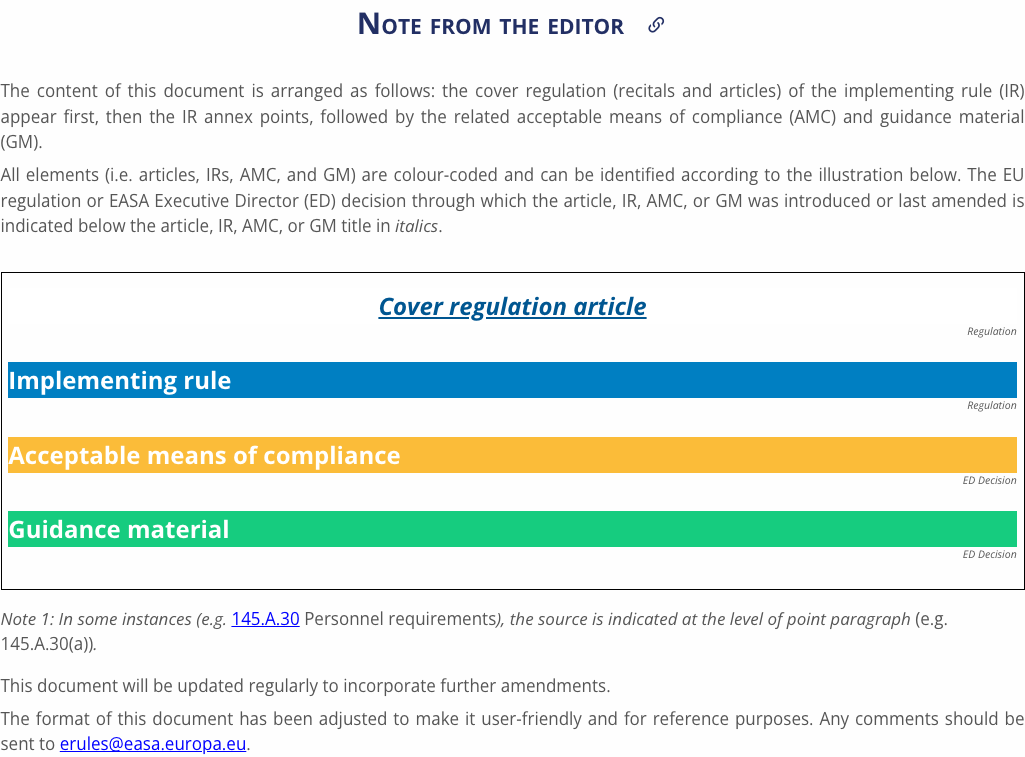
Figures 1.3 to 1.5 show the source notes for 145.A.10 and its AMC and GM as they appear in the 2025-09 EAR. The rule shows Regulation (EU) 2021/1963; the AMC and GM show ED Decision 2022/011/R.



Figure 1.5 is a live example of the cut-off problem. ED Decision 2026/002/R amended GM1 145.A.10 with effect from 2026-02-04, after the EAR revision was published, so the green heading still names ED Decision 2022/011/R even though the current text comes from the 2026 Decision. The same happens in Part-CAMO itself: the 2025-09 EAR shows CAMO.A.220 as last amended by Regulation (EU) 2019/1383, while Regulation (EU) 2026/100 replaced its points (a)(3) to (a)(6) and added (a)(7) and (a)(8). Someone working from the EAR alone would apply the old retention rules for airworthiness review records.
Regulatory basis: what this course includes
This course teaches the sources below as amended up to the act or decision shown. Anything published after it is not part of this edition of the course.
| Source | Included up to |
|---|---|
| Regulation (EU) No 1321/2014 — Annex Vc (Part-CAMO) and its Part-M interfaces | Implementing Regulation (EU) 2026/100 (applicable from 2026-08-07) |
| Regulation (EU) No 748/2012 — Part-21 interfaces taught | Delegated Regulation (EU) 2026/56 and Implementing Regulation (EU) 2026/100 (applicable from 2026-08-07) |
| Implementing Regulation (EU) 2015/1018 (occurrence lists) | Implementing Regulation (EU) 2026/1821 (applicable from 2026-08-17) |
| AMC & GM to Part-CAMO | ED Decision 2026/005/R (Issue 1, Amendment 6) |
| AMC & GM to Part-M | ED Decision 2026/005/R (Issue 2, Amendment 10; file corrected 2026-09-22) |
| AMC & GM to Part-ML | ED Decision 2026/005/R (Issue 1, Amendment 4) |
Checked against the official texts on 2026-11-22. Before relying on a point at work, check the current consolidated text on EUR-Lex and the AMC & GM currently published by EASA, including any later ED Decision.
A five-minute currency check
Do this whenever a decision depends on the exact wording of a rule:
- Note the EAR revision you are reading and its date.
- Open the EASA continuing airworthiness regulations page and look for newer material adopted after the compilation’s cut-off.
- For each one that touches your point, open the Official Journal text on EUR-Lex and read its application article.
- Check the AMC/GM issue and amendment for the Part you are using against the regulatory-basis table.
- Write down the source, version and date you relied on, then follow your organisation's procedure for updating controlled documents.
EASA FAQs explain common questions but do not amend the rules. Check their references against the current provision, particularly where a later amendment moved the subject to another point.
At work: Record the rule, amendment, application date and AMC/GM edition behind a live decision. If your compilation omits a later applicable change, obtain that text before updating a procedure.
Where Part-CAMO is published and how to keep it current
3 questions · Retry freely · Separate from your final exam
Choose an action, check its consequence and explore the alternatives. Your practice answers are not saved.
On 2026-11-17, the technical services engineer at fictional Example CAMO Ltd revises CAME AV-REC-02 for its regional turboprops. Her saved Easy Access Rules show CAMO.A.220 with source note Regulation (EU) 2019/1383. The amendment register also contains Regulation (EU) 2026/100 and ED Decision 2026/005/R.
- Easy Access Rules
- Revision from 2025-09, published 2025-09-10
- Regulation (EU) 2026/100
- Published 2026-01-19; in force 2026-02-08; applies from 2026-08-07 (Article 3(1) and 3(2) earlier)
Compare all answers and explanations
The 2025-09 Easy Access Rules text, as EASA's latest consolidated revision. — Consider the consequence.
The Easy Access Rules are a reading aid with a cut-off of 2025-09-10. Regulation (EU) 2026/100 replaced CAMO.A.220(a)(3) to (a)(6) after that date, so this text is out of date.
CAMO.A.220 as amended by Regulation (EU) 2026/100, read in the Official Journal. — Best choice.
Correct. The Official Journal is the legal publication, and the amended text has applied since 2026-08-07.
The Regulation (EU) 2019/1383 text until EASA publishes the next consolidated revision. — Consider the consequence.
A consolidation's publication date does not postpone an amendment. The new text applies from the date in Article 4 of Regulation (EU) 2026/100, whether or not the Easy Access Rules have caught up.
Compare all answers and explanations
As CAMO.A.220(a)(8), a binding implementing rule. — Consider the consequence.
CAMO.A.220(a)(8) requires the records to be transferred to the owner when the organisation ceases operations. The written statement comes from the AMC, which is written with 'should'.
As GM1 CAMO.A.220, explanatory material with no compliance role. — Consider the consequence.
The statement is not in GM. It is acceptable means of compliance, which is one accepted way to meet the rule.
As AMC1 CAMO.A.220(a)(8), adopted by ED Decision 2026/005/R. — Best choice.
Correct. Quoting the exact label lets the next reader find the text and see that it is AMC, not part of the rule.
Compare all answers and explanations
ED Decision 2026/005/R, which adopted AMC and GM to Part-CAMO Issue 1, Amendment 6. — Best choice.
Correct. ED Decision 2026/005/R is dated 2026-07-03 and was published on 2026-07-06. Its Part-CAMO AMC/GM Amendment 6 applies from 2026-08-07.
ED Decision 2026/002/R, which amended the Part-CAMO AMC and GM in 2026-02. — Consider the consequence.
ED Decision 2026/002/R amended AMC and GM to Part-M, Part-145, Part-66, Part-147, Part-ML and Part-CAO. It did not issue the current Part-CAMO amendment.
Regulation (EU) 2025/111, which carries the AMC for electric aircraft management. — Consider the consequence.
Regulation (EU) 2025/111 is a Commission implementing regulation. AMC and GM are adopted by EASA through ED Decisions, not by regulations.
Sources checked 2026-11-17. Regulation (EU) No 1321/2014: Articles and CAMO.A.220; Part-CAMO AMC/GM Issue 1, Amendment 6; Regulation (EU) 2026/100.
Continue with lesson 2: The cover regulation and when a CAMO is needed
€65 per seat + VAT where applicable
Get the syllabus by email
Not ready to buy? We email you the printable syllabus, the free lesson and the course page.