EASA Part-CAO & Part-ML Regulations — Initial
Free lesson preview: EASA Part-CAO & Part-ML Regulations — Initial
EASA Part-CAO and Part-ML Regulations Initial Training
Lesson 1 of 16, exactly as learners see it. No sign-in needed; practice answers are not saved.
- 6 hours learning
- 12 questions, 18 min
- Certificate at 75 %
Lesson 1 of 16
How to read the Part-CAO and Part-ML publication set
Learning objective: Distinguish the binding regulation, AMC, GM, FAQs and local CAE procedures, and identify which 2025–2026 amendments change the rules you apply.
This course is for people who work in or with a combined airworthiness organisation (CAO) and for owners, planners and certifying staff who look after light aircraft under Part-ML. It covers the cover regulation and its Articles, every point in Section A of Part-CAO (Annex Vd) and Part-ML (Annex Vb), their five binding appendices and an overview of what the competent authority does under Section B. Completing it records course knowledge. It does not grant an organisation approval, a licence, a certification or airworthiness-review authorisation, or permission to release or operate an aircraft; those come only from the authority or from your organisation's own procedures.
All unnamed scenarios are fictional training examples. Zedland (ZZ) represents a State applying the EU aviation rules; fictional approvals and AV- references are teaching exhibits, not maintenance instructions.
This opening lesson introduces both Parts together, because in practice they meet on the same aircraft. Picture a four-seat piston aeroplane of 1,150 kg maximum take-off mass (MTOM) owned by a flying club. Part-ML tells the club, as owner, what has to happen to keep that aircraft airworthy: a maintenance programme, defect control, records, and periodic airworthiness reviews that keep a valid airworthiness review certificate (ARC).
An ARC is valid for a year, and an eligible aircraft can have it extended twice between full reviews. Part-CAO tells the organisation that the club hires what it must be and do to be approved to maintain the aircraft, manage its continuing airworthiness or review it. Two different questions, two different Annexes, one aircraft.
The layers of the rule book
The legal chain runs from Regulation (EU) 2018/1139 (the Basic Regulation) to Commission Regulation (EU) No 1321/2014. That regulation has a cover regulation of Articles 1 to 8 followed by its Annexes: Annex I Part-M, Annex II Part-145, Annex III Part-66, Annex IV Part-147, Annex Va Part-T, Annex Vb Part-ML, Annex Vc Part-CAMO and Annex Vd Part-CAO. Implementing-rule points are written as obligations ("shall") and bind the person or organisation they address.
The institutional chain matters when you check whether a rule is current. EASA supports Union aviation rulemaking and issues Opinions containing proposed rules. Under the Basic Regulation, the European Commission adopts the applicable delegated or implementing regulations, and publication in the Official Journal of the European Union is the legal publication. EASA Executive Director Decisions adopt AMC and GM and, where relevant, certification specifications (CS). EASA does not issue Commission regulations. Regulation (EU) 2026/100, for example, records in its recitals that it follows EASA Opinion No 08/2024.
| Level | Who adopts it | Status in practice | Example |
|---|---|---|---|
| Implementing rule (IR) | European Commission, published in the Official Journal | Binding ("shall") | ML.A.902(a): an ARC is valid for 1 year |
| Acceptable means of compliance (AMC) | EASA Executive Director Decision | Not binding, but following it is accepted as showing compliance; another method needs the alternative-means route in CAO.A.017 | AMC1 CAO.A.045: recent-experience test for review staff |
| Guidance material (GM) | EASA Executive Director Decision | Explains and illustrates; creates no obligation | GM1 ML.A.202: when a report goes through an organisation's system |
| Combined airworthiness exposition (CAE) | The CAO, approved by its competent authority | Binds the organisation's staff; cannot widen the rule | The CAE procedure for one-off certification authorisations |
EASA FAQs sit outside that table. They are answers EASA publishes to recurring questions. They are useful, they carry a date, and they are not binding. For example, an ARC-extension FAQ may explain the date calculation while citing an old paragraph number. Check the explanation against the current implementing rule before using it in the CAE.
What changed in 2025 and 2026
These four publications explain the main changes to the Part-CAO and Part-ML provisions below. Figure 1.1 puts them in order; the table lists what each one changed.
| Publication | Dates | What it changed for this course |
|---|---|---|
| Commission Implementing Regulation (EU) 2025/111 | Adopted 2025-01-23; OJ 2025-01-24; applies from 2026-02-13 | Articles 2 and 3 and ML.1 (non-conventional aircraft enter Part-ML scope), ML.A.302, CAO.A.020 and CAO.A.105 (electric engines), and Part-ML Appendix III (batteries, fuel cells, high-pressure power-plant systems) |
| ED Decision 2026/002/R | Signed 2026-01-30; published 2026-02-03 | AMC and GM supporting 2025/111: AMC & GM to the Articles Issue 1 Amendment 4, Part-ML Issue 1 Amendment 3, Part-CAO Issue 1 Amendment 5 |
| Commission Implementing Regulation (EU) 2026/100 | Adopted 2026-01-15; OJ 2026-01-19; entry into force 2026-02-08; general application date 2026-08-07 | ML.A.202 and ML.A.901 to ML.A.907; Part-ML Section B (ML.B.902 and ML.B.903 deleted); Part-ML Appendix I point (f) and a new EASA Form 15c; CAO.A.025, CAO.A.045, CAO.A.085, CAO.A.090 and CAO.A.095; new CAO.A.120 and CAO.B.075 |
| ED Decision 2026/005/R | Published 2026-07-06 | Part-ML Issue 1 Amendment 4 (AMC1 and GM1 ML.A.202, GM1 ML.A.901, AMC1 ML.A.903(i)); Part-CAO Issue 1 Amendment 6 (AMC1 CAO.A.025, AMC1 CAO.A.100(a), GM1 CAO.A.095(c)(2)) |
Regulation 2026/100 also has two corrections with their own application dates: Article 3(1), which corrects the Part-66 derogation in Article 5(8) for electric aeroplanes, applies from 2026-02-13, and Article 3(2), which corrects the numbering in CAMO.B.300, applies from 2026-02-22. Neither changes Part-CAO or Part-ML, but they show why you read the application article of every amending act rather than assume one date for all of it.
In Figure 1.1, the regulation markers show adoption dates. The supporting ED Decision markers show publication dates, not application dates.
The Easy Access Rules and their limits
EASA's Easy Access Rules (EAR) put the implementing rules, AMC and GM side by side. The 2025-09 Continuing Airworthiness compilation was published on 2025-09-10. EASA's publication page states that Regulation (EU) 2025/111 is not incorporated in it, and it pre-dates Regulation 2026/100 and both 2026 ED Decisions. Use it to find your way, then read the amending acts for every point in the table above.
Check the procedure against the amended rule
Fictional example: the planner at Example Aero Services Ltd, Zedland (ZZ), opens CAE D.7 revision 2 to extend a club aeroplane’s ARC. The procedure cites ML.A.901(c). She compares it with the amended rule and finds that extension is now in ML.A.902. She checks the conditions and date calculation, raises a controlled CAE amendment and briefs the authorised staff before use. A familiar paragraph number is not evidence that the procedure is current.
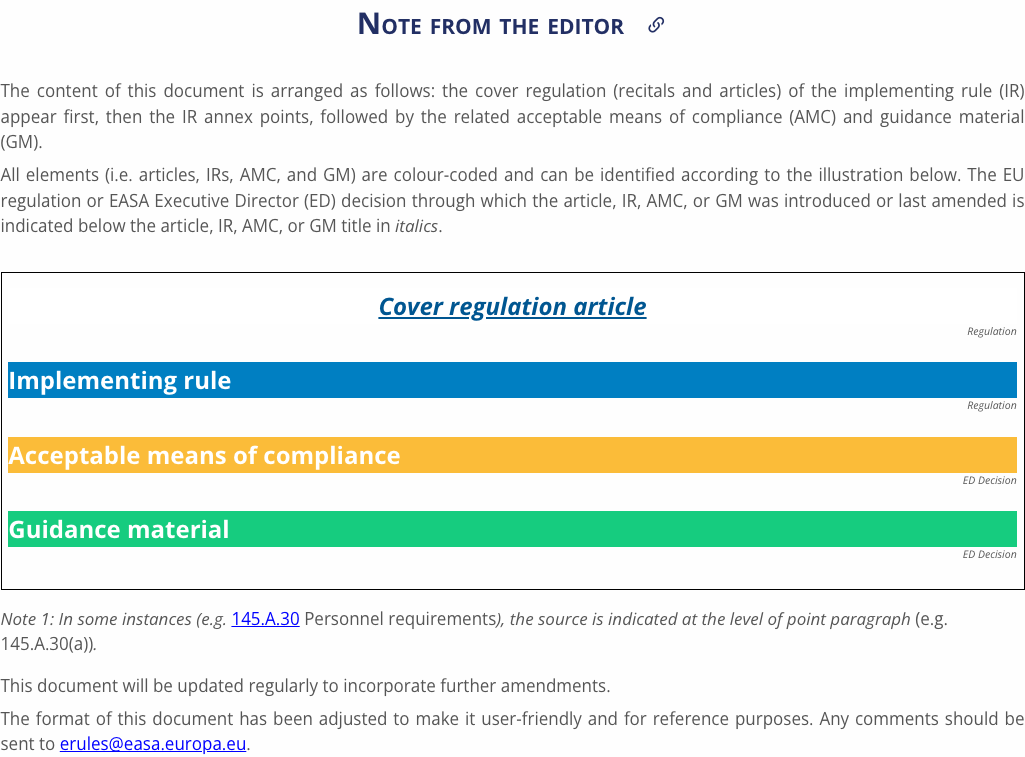
The EAR uses colour to show status, and each heading carries a source note in italics naming the regulation or ED Decision that introduced or last amended the item (Figure 1.2). The examples in Figures 1.3 to 1.5 are Part-145 points taken from the 2025-09 compilation. They show how the convention works, and also why the source note itself must be checked: the compilation shows ED Decision 2022/011/R under GM1 145.A.10, but ED Decision 2026/002/R amended that GM with effect from 2026-02-04 (Decision Article 2). In this course the same applies to GM1 CAO.A.020, which 2026/002/R also amended.



Regulatory basis: what this course includes
This course teaches the sources below as amended up to the act or decision shown. Anything published after it is not part of this edition of the course.
| Source | Included up to |
|---|---|
| Regulation (EU) No 1321/2014 — Articles, Annex Vb (Part-ML) and Annex Vd (Part-CAO) | Implementing Regulation (EU) 2026/100 (applicable from 2026-08-07) |
| AMC & GM to the Articles of Regulation (EU) No 1321/2014 | ED Decision 2026/002/R (Issue 1, Amendment 4) |
| AMC & GM to Part-ML | ED Decision 2026/005/R (Issue 1, Amendment 4) |
| AMC & GM to Part-CAO | ED Decision 2026/005/R (Issue 1, Amendment 6) |
Checked against the official texts on 2026-11-17. Before relying on a point at work, check the current consolidated text on EUR-Lex and the AMC & GM currently published by EASA, including any later ED Decision.
Reading a point the way an auditor does
When a question lands on your desk, trace it in the same order every time: the implementing-rule point that creates the duty, the AMC or GM that shows an accepted way to meet it, any other Part it hands you to (for example CAO.A.085 sends a CAO's airworthiness reviews to ML.A.903), and finally your CAE procedure. Suppose a planner asks whether the CAO may extend a club aircraft's airworthiness review certificate (ARC) that ran out last week. The answer starts at ML.A.902 (validity and extension), moves to CAO.A.095(b)(4) (the CAO's extension privilege) and ends at the CAE procedure listed in the AMC1 CAO.A.025 layout. Lesson 12 works through it.
Worked example
The CAE extension procedure still quotes the pre-2026 wording of ML.A.901(c).
The procedure is out of date. Since 2026-08-07 ARC extension is governed by ML.A.902(a) and (b), and CAO.A.095(b)(4) refers to that point. Raise a CAE amendment through the CAO.A.105 change procedure and brief the staff who extend ARCs before they next use it.
At work: Check the current rule, its AMC or GM and the approved CAE procedure before acting. Record the paragraph and edition used.
Sources checked 2026-11-17. Regulation (EU) No 1321/2014; Regulation (EU) 2018/1139; Commission Implementing Regulations (EU) 2025/111 and 2026/100; ED Decisions 2026/002/R and 2026/005/R; Easy Access Rules September 2025. Regulation 1321/2014, consolidated 2026-08-07. Regulation 2026/100. ED Decision 2026/002/R, Article 2.
Rebuilding a CAE reference list after the 2026 amendments
3 questions · Retry freely · Separate from your final exam
Choose an action, check its consequence and explore the alternatives. Your practice answers are not saved.
Fictional training case in Zedland (ZZ). The quality manager at Example Aero Services Ltd checks CAE A.2 revision 5. On 2026-10-20 a CAO quality manager rebuilds the CAE reference list. The library holds the 2025-09 Easy Access Rules PDF, the Official Journal text of Regulations 2025/111 and 2026/100 and both 2026 ED Decisions. The planner's ARC extension procedure still quotes ML.A.901(c), and he wants to prove review-staff recency in a way that differs from the AMC.
- Compilation
- Easy Access Rules, Continuing Airworthiness, revision of 2025-09-10
- Amending acts
- Reg 2025/111 (applies 2026-02-13); Reg 2026/100 (applies 2026-08-07)
- AMC/GM
- ED Decisions 2026/002/R (2026-02-03) and 2026/005/R (2026-07-06)
Compare all answers and explanations
ML.A.901(c) as printed in the 2025-09 Easy Access Rules, the latest consolidated edition. — Consider the consequence.
The compilation is a reading aid published before Regulation 2026/100. It still shows the old ML.A.901(c), which no longer governs extensions.
ML.A.902 as replaced by Regulation 2026/100, which has applied since 2026-08-07. — Best choice.
The implementing rule in force on the day of the extension governs. Since 2026-08-07 the extension rules are in ML.A.902(a) and (b), and CAO.A.095(b)(4) refers to them.
GM1 ML.A.901 as amended by ED Decision 2026/005/R, which sets the extension conditions. — Consider the consequence.
GM explains a rule and creates no obligation. GM1 ML.A.901 is about who may perform a review, not about extension conditions, which sit in ML.A.902.
Compare all answers and explanations
A full description and compliance assessment for the authority, then its prior approval. — Best choice.
Departing from AMC1 CAO.A.045 is an alternative means of compliance. CAO.A.017 requires a full description with an assessment, prior approval and the authority's notification under CAO.B.017 before use.
An internal assessment signed by the quality manager, as AMC is not binding. — Consider the consequence.
AMC is not binding, but CAO.A.017 turns any different method into an alternative means of compliance that needs prior approval. An internal signature does not replace it.
A note in the CAE describing the method as guidance material, so that no approval is required. — Consider the consequence.
Calling a method guidance does not change what it is. A different way of meeting the rule than the AMC still goes through CAO.A.017 before it is used.
Compare all answers and explanations
As the current consolidated text, since EASA has not yet published a newer revision of it. — Consider the consequence.
The absence of a newer compilation does not make the old one current. The amending acts apply whether or not a consolidation includes them.
As withdrawn material to be removed, since newer acts have replaced parts of it. — Consider the consequence.
The compilation is still useful for finding your way and for unchanged points. The right response is to record its limits, not to discard it.
As a reading aid of 2025-09-10 that does not include 2025/111, 2026/100 or the 2026 ED Decisions. — Best choice.
EASA's own page says Regulation 2025/111 is not incorporated, and the compilation pre-dates 2026/100 and both 2026 ED Decisions. Recording that limit stops staff treating it as current text.
Continue with lesson 2: Regulation 1321/2014: Articles, applicability and competent authorities
€69 per seat + VAT where applicable
Get the syllabus by email
Not ready to buy? We email you the printable syllabus, the free lesson and the course page.